
Metered certification evidence. In Sustainix.
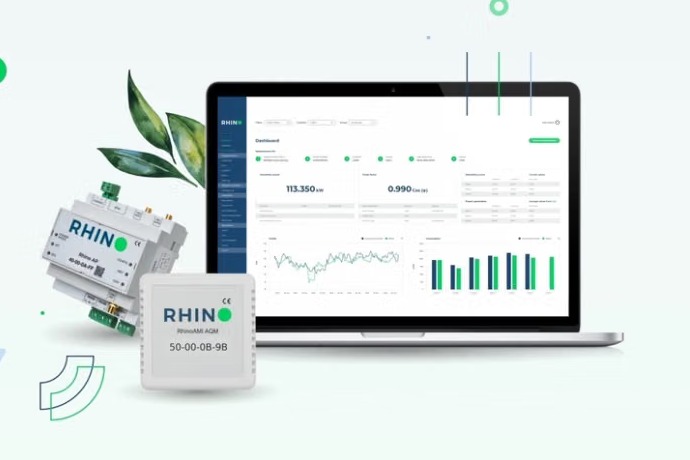
Rhino connects to your meters across electricity, gas, water and heat, down to submeter level, plus on-site generation. Consumption flows into Sustainix AI by API. Ten BREEAM-NL In-Use credits run on measurement rather than on documents, led by ENE 19 actual energy consumption. No manual reads, no estimated figures.
Rhino measures. Sustainix AI certifies.
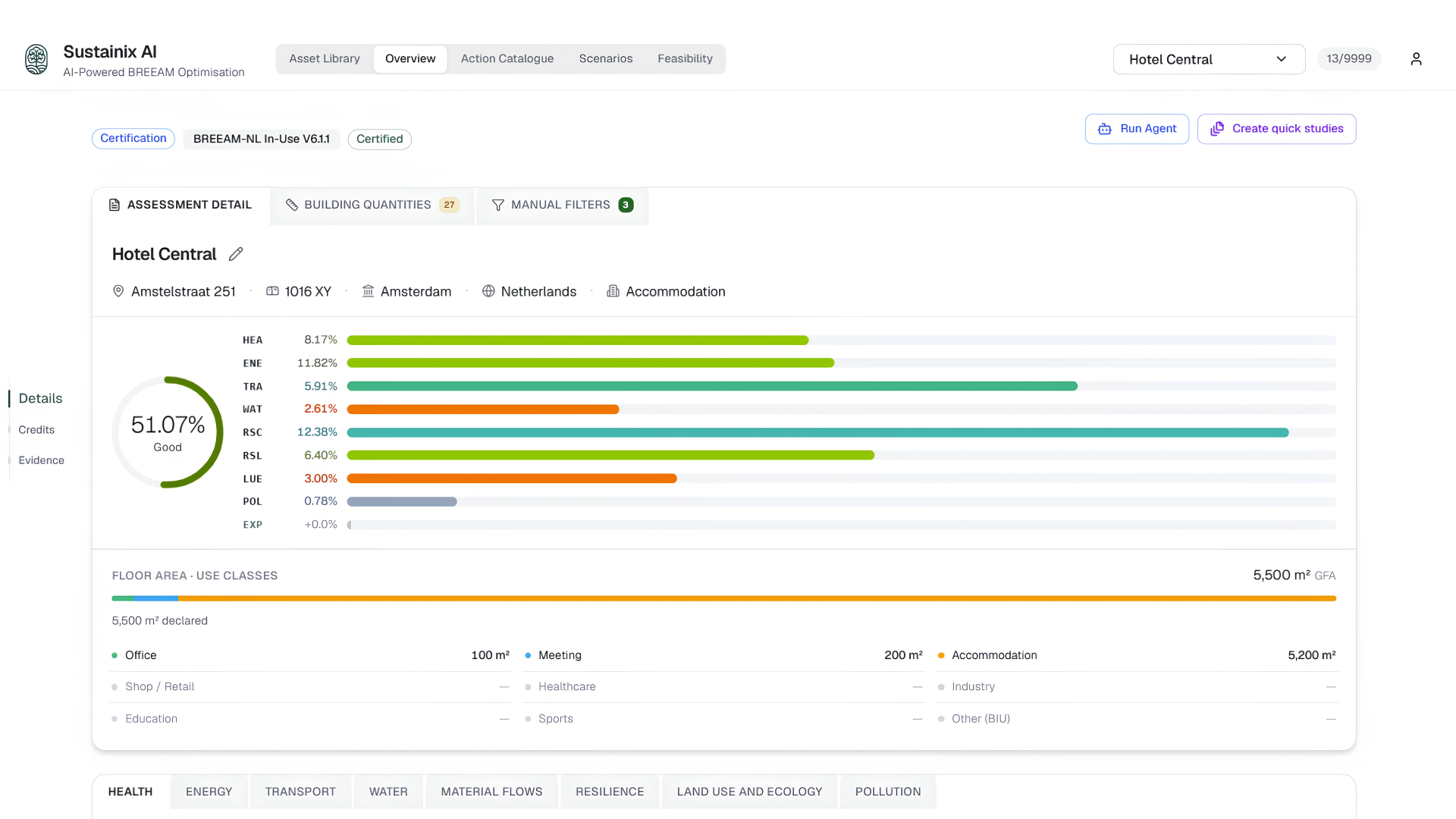
Sustainix AI reads the record of a building: every document classified, every credit scored, evidence drafted to submission standard and signed by a licensed assessor. Rhino reads the building itself. There is nothing to argue about at the boundary, because one of these is a filing problem and the other is a measurement problem.
The measurement the energy and water credits rest on
- Reads the meter, not the recordElectricity, gas, water and heat down to submeter level, plus on-site generation, at 15-minute resolution from day one.
- Arrives on its ownEvery other input to a certification is a file someone has to find. Meter data is a feed. Nobody chases it.
- Carries a meter ID and a timestampWhen an assessor asks how a consumption figure was derived, the answer is a serial number and a read time, not a spreadsheet.
- Senses the indoor environment tooTemperature, humidity, CO2, VOC and particulates, from the same platform as the meters.
- Holds one structure across the portfolioThe same format in every asset in 35 countries, whether Rhino connects by utility network API, by its own hardware, or through infrastructure already in the building.
Everything between the evidence and the certificate
- Knows what every credit asks forScheme logic, scoring and the thresholds behind each rating tier, credit by credit.
- Reads the documentsLabels, drawings, contracts, prior assessments and photos, ingested and mapped to the credits they support.
- Signs itA licensed BREEAM assessor verifies every credit on site and carries it to the certifier.
- Models the capitalInvestment per rating tier, actions ranked by score impact, a client-ready roadmap.
- Holds the scheme relationshipsDutch Green Building Council partner and BREEAM Awards 2026 finalist, with EPBD and EU Taxonomy workflows alongside.
This is the smart way to get a building certified, because each half covers the other's blind spot. A meter feed with no scheme behind it is a chart. A rating assembled only from documents describes a building at a moment that has already passed. Put them together and the certificate becomes an operating position: current, traceable to a meter ID, and signed by a licensed assessor.
Ten credits run on measurement
Mapped against BREEAM-NL In-Use Utiliteitsbouw v6.1.1. These are the credits where the evidence is a reading rather than a document, which is exactly why they are the ones that stall a certification.
| Credit | Part | What it scores | Points |
|---|---|---|---|
| ENE 19 | Management | Actual energy consumption, WEii and Paris Proof. Mandatory, minimum 25 | 50 |
| WAT 01 | Asset | Water consumption metering. Mandatory, minimum 2 | 6 |
| ENE 15 | Asset | Monitoring of energy consumption | 4 |
| ENE 16 | Asset | Monitoring of lettable space | 4 |
| WAT 07 | Asset | Leak detection, flow-based detection at the meter | 4 |
| ENE 22 | Management | Energy-saving research | 4 |
| ENE 23 | Management | Use of information on energy consumption | 4 |
| ENE 102 | Management | Performance assurance of installations | 4 |
| WAT 13 | Management | Monitoring and reporting water consumption | 4 |
| WAT 11 | Management | Drinking water consumption | 3 |
87 of 439 raw points across both parts. In Part 2, where a certification is won and lost, the feed carries 69 of 198. Two of these credits set mandatory minimums, so without meters a rating is not merely lower, it is capped. Credit values per v6.1.1. The certificate score weights the nine categories, so the share of a final score differs per building, and ENE 16 also requires the lettable-area register alongside the readings.
The rating is capped without them
Fifty points on one credit
ENE 19 scores actual energy consumed against Paris Proof targets. It is the biggest single credit on the Management side, it is mandatory at 25 points for Excellent, and a calculated energy label does not reach it. It needs a meter.
Coverage comes before credits
Sub-metering covering at least 90% of consumption is a precondition for running an integrated programme at all. That is not a document anyone can produce. It is a condition a building either meets or does not.
Alarms that score
WAT 07 accepts flow-based detection of higher-than-normal volumes at the meter or submeter. Rhino's threshold and periodic consumption alarms do exactly that, so a monitoring feature becomes a credit.
Policy that holds up
MAN 02 engagement and MAN 04 environmental policy carry mandatory minimums, and MAN 05 covers green leases. Sustainix writes the policy. Rhino supplies the data that turns a target into a scored fact, and a green lease clause on tenant consumption is unenforceable without lettable-area data.
From meter to certificate. Four steps.
Once Rhino is connected the flow is automated. No periodic exports, no reconciliation, no data hunt before each assessment.
- Step 1
Meter connection
Rhino connects to your electricity, gas, water and heat meters, plus on-site generation, by utility network API, by Rhino hardware, or through infrastructure already installed in the building. Existing meters are used wherever possible, so capital expenditure stays low.
- Step 2
Continuous collection
Consumption is collected at 15-minute resolution, timestamped and structured, with anomalies flagged automatically. The data keeps arriving between assessments, not only in the weeks before one.
- Step 3
API delivery into Sustainix
Normalized submeter data is delivered into the Sustainix workspace by API, alongside the document record, in one format across every building in the portfolio.
- Step 4
Scored and signed
Sustainix scores every credit against the evidence, drafts submission-ready answers traced to source, and a licensed assessor verifies on site and signs before anything reaches the certifier.
From meter to certified score
Two systems, one handover. Rhino owns everything up to the reading. Sustainix owns everything after it.
The practical difference for an owner is where the effort goes. Without the integration, ENE 19 and the nine credits behind it are a data-collection project every cycle. With it, the consumption evidence is already in the platform when the assessment starts, and the work that remains is the judgement an assessor is paid for.
AI-native certification, with an assessor behind it
Sustainix AI gets commercial buildings green-certified and keeps them that way. Documents go in once, the AI classifies and scores every credit against them, and a licensed assessor verifies each answer on site before anything reaches the certifier. The compliance record stays in one place, and it stays the owner's.
Founded in Amsterdam, a Dutch Green Building Council partner and a BREEAM Awards 2026 finalist in Digital Sustainability Innovation. BREEAM and climate risk are live today, with LEED, HQE and DGNB following in 2027, alongside EPBD and EU Taxonomy workflows.
No LLMs in the math
Sustainix computes every score, cost and carbon figure with tested formulas rather than a language model, and a licensed assessor signs the result. Rhino applies the same discipline one layer down: a reading, never an estimate. Two companies, two checks, one number.
Sustainix x Rhino, answered
Rhino connects your meter estate and streams normalized consumption data into Sustainix AI by API. Sustainix scores the credits that depend on measurement, drafts the evidence and has a licensed assessor verify and sign it.
Certifying a portfolio? Put a metered number behind it.
Rhino connects your meter estate and starts feeding the credits that decide the rating. Book a demo and we will assess your portfolio in the first session.
Book a demo