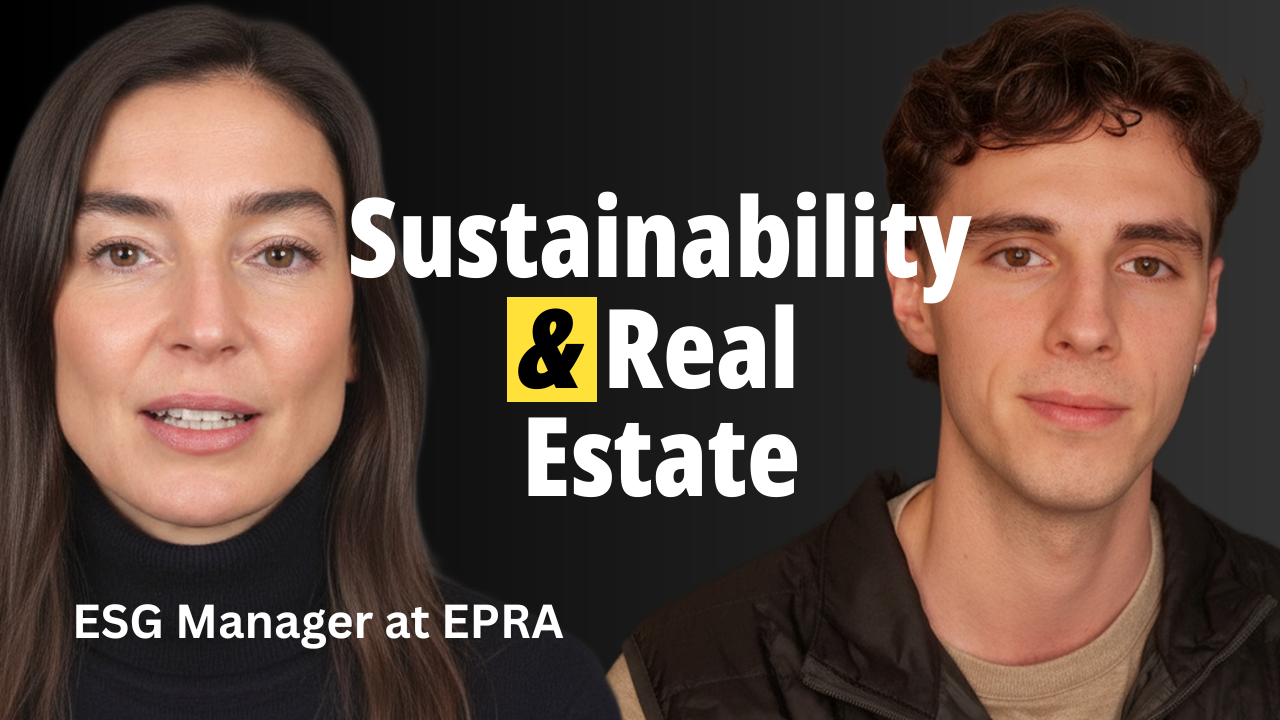

EPRA's ESG Manager Lourdes Calderón Ruiz reveals why green buildings certifications are essential for real estate owners, how AI is transforming sustainability assessments, and the future of green building standards in Europe.
Reducing Uncertainty in Sustainable Real Estate Investment
In today's rapidly evolving real estate landscape, sustainability is no longer optional it's essential. But the question facing property owners and investors isn't whether to invest in sustainability, but rather how to reduce uncertainty around operational performance, future capital expenditure (CAPEX), tenant experience, and long-term asset value.
The challenges are real and pressing. Real estate companies face mounting pressure from multiple directions: regulators demanding climate action, investors requiring ESG transparency, tenants expecting healthier buildings, and communities insisting on social responsibility. Yet amidst these demands, many struggle with fundamental questions about where to invest, how to measure success, and what truly creates value in sustainable buildings.
In a recent podcast conversation, Dragos Avram sat down with Lourdes Calderón Ruiz, ESG Manager at EPRA (European Public Real Estate Association), to discuss the role of BREEAM certification in addressing these critical challenges. Working at the nexus of ESG and listed real estate since 2019, with a specific focus on sustainability since 2023, Lourdes provides unique insights into how building certifications serve as essential tools for reducing market uncertainty and driving informed investment decisions.
The conversation reveals why BREEAM launched in 1990 as the world's first building certification system remains remarkably relevant in 2026, and how emerging technologies like artificial intelligence are transforming its accessibility and effectiveness for real estate companies of all sizes.
Understanding BREEAM: More Than Just a Marketing Label
The Origins: Solving a Critical Market Problem
BREEAM (Building Research Establishment Environmental Assessment Method) wasn't created as a marketing label or badge to display on building facades. According to Lourdes, it was created as a practical tool to measure performance and compare assets so markets can make better decisions when facing uncertainty. This distinction matters because it fundamentally shapes how companies should approach and use certification.
The story begins in the 1980s when researchers and policymakers confronted an uncomfortable reality: buildings consumed vast amounts of energy and resources, yet regulation only set minimum standards. This left a significant gap. On one side, buildings were major contributors to environmental impact. On the other, investors, occupiers, and public authorities had no common framework to compare building performance beyond basic legal compliance.
The market needed a way to answer questions like: How does this building's energy performance compare to others? What environmental benefits justify higher rents or purchase prices? Which sustainability investments actually deliver value? Without standardized metrics, these conversations relied on opinions rather than data a situation that created risk and inefficiency for all stakeholders.
This information gap led the UK Building Research Establishment to launch BREEAM in 1990 as the world's first building certification system a pioneering solution that would fundamentally change how we assess and value sustainable buildings. It provided the missing link: an independent, third-party verification system that could translate sustainability claims into comparable, verifiable performance data.
What BREEAM Actually Measures
BREEAM was designed to provide clear, measurable indicators across critical building performance areas. The framework covers:
- Energy efficiency and consumption
- Water usage and conservation
- Material selection and environmental impact
- Indoor environment quality including air quality, lighting and acoustics
- Management practices for real estate assets
"It's not about a brand, it's not about providing a simple label. It's about being able to benchmark performance, turning opinions into data and helping the market to understand risk, to plan CAPEX and to value assets more accurately."
This data-driven approach addresses the core challenge real estate companies face: making informed decisions about sustainability investments when outcomes are uncertain. By providing standardized metrics and independent verification, BREEAM transforms sustainability from a subjective concept into a measurable business parameter.
Why Some Companies Miss the Point of BREEAM Certification
The Added Value Beyond the Certificate
Despite BREEAM's widespread use today, Lourdes observes that some companies don't fully understand why certification is needed. They treat it as a "nice to have" checkbox rather than recognizing its fundamental value in reducing CAPEX uncertainty and improving asset valuation.
The certification helps companies in three critical ways:
- Reducing capital expenditure uncertainty by focusing investments on what truly matters
- Improving asset valuation through verified performance data
- Providing benchmarking tools for portfolio-wide decision-making
What BREEAM Was (and Wasn't) Designed to Do
Understanding BREEAM's purpose requires clarity about its intended function versus common misconceptions.
BREEAM was created to:
- Reduce information gaps in the market
- Provide independent third-party verification
- Signal quality and consistency across portfolios
- Support better decisions in uncertain markets
BREEAM was never meant to:
- Guarantee higher rents automatically
- Guarantee higher asset values without operational improvements
- Replace building regulation and legal requirements
As Lourdes points out, certification provides the framework and verified data but market outcomes depend on how effectively owners use these tools to improve actual building performance.
The Operational Benefits of BREEAM for Asset Owners and Managers
For property owners and asset managers, BREEAM certification delivers concrete operational advantages. It enables systematic measurement and benchmarking of existing buildings, assessing energy consumption, waste management, material efficiency, air quality, and occupant health metrics. The structured, internationally recognized framework creates comparable KPIs across portfolios and companies, facilitating investor due diligence and ESG compliance reporting.
"When investors check reports and assess several companies, it's important to have comparable KPIs."
Beyond environmental metrics, BREEAM addresses critical social factors including wellbeing considerations, accessibility features, improved air quality, lighting, noise control, and thermal comfort. These elements enhance the tenant daily experience and support community integration social factors increasingly important in regulatory frameworks and stakeholder expectations, making BREEAM's holistic approach particularly valuable.
Addressing the Challenges: Why Some Companies Hesitate on Certification
The Cost and Resource Reality
Lourdes brings a refreshingly honest perspective to the challenges companies face with building certifications. Rather than dismissing concerns, she acknowledges the legitimate barriers that prevent some organizations from pursuing BREEAM.
Certifications are costly and resource-intensive, requiring significant time investment from both internal teams and external assessors. The process involves detailed documentation, evidence gathering, and coordination across multiple stakeholders. For companies already stretched thin managing portfolios and responding to regulatory demands, adding certification to the workload can feel overwhelming.
Moreover, not all stakeholders directly request certification. If investors aren't explicitly asking for BREEAM in their due diligence, if tenants aren't making it a lease requirement, and if local regulations don't mandate it, the pressure to invest resources in certification diminishes. Companies must prioritize among competing demands for limited capital and attention.
"I completely understand. At the end of the day, they have to set priorities and whenever there is not a very clear business case, they don't buy it."
This honest assessment highlights a critical gap in the market: while certifications deliver substantial value, their benefits must be clearly articulated and demonstrated to justify the investment. Companies need to see the direct connection between certification costs and tangible business outcomes whether through improved asset values, reduced operating costs, enhanced tenant satisfaction, or better access to capital.
Building the Business Case for BREEAM Certification
So how can real estate companies justify the investment in BREEAM certification? Lourdes outlines several compelling arguments that go beyond reputation.
BREEAM functions as a strategic management tool for CAPEX, helping companies focus capital expenditure on improvements that genuinely matter. With CAPEX budgets encompassing multiple potential investments, certification helps prioritize improvements that deliver the greatest performance and value gains.
The certification process also serves as a diagnostic toolkit for identifying issues early particularly valuable when regulations and market expectations evolve rapidly. Certified buildings demonstrably improve experiences for tenants and surrounding communities, strengthening long-term relationships and reducing vacancy risk.
"It's very important that we all speak the same language."
Perhaps most importantly for listed real estate companies, BREEAM provides a common language for communicating with investors and lenders. This shared framework enables clearer dialogue about asset quality, performance, and value creation strategies.
Why BREEAM Matters More Now Than Ever
The urgency around building certification has intensified due to converging regulatory and market pressures:
- Stronger EU climate and energy regulations, including the Energy Performance of Buildings Directive (EPBD) and CSRD disclosure expectations
- Investors demanding verified performance data
- Occupiers caring more about wellbeing and social impact
- Stakeholders actively expressing their expectations
"Assets without credible performance data are becoming harder to defend in the market and in financial discussions. Certification is moving from a nice-to-have to a baseline expectation."
The market is establishing new minimum expectations around building performance verification. "There are certain basis KPIs such as the BREEAM certification that I think are becoming kind of seen as a sine qua non in order to warrant that your asset is a good asset," Lourdes explains. This shift reflects investor sophistication and regulatory evolution, where verified sustainability performance is increasingly integral to asset valuation and risk assessment.
The Future: AI's Role in Transforming BREEAM Certification
"The role of AI is extremely important. It's not the solution for everything, but it helps almost everything to advance faster."
AI addresses the primary barriers to BREEAM adoption cost and time through:
- Automated data collection: Training AI systems to gather required performance data automatically, reducing manual work and minimizing human error
- Precision in calculations: Ensuring calculations are precise for meaningful performance improvement
- Keeping assessments current: Enabling continuous monitoring rather than periodic snapshots
"This doesn't mean that this process doesn't need the help of a human person, which I think it's also important to keep it there in the equation."
While acknowledging AI's resource intensity in training, both Dragos and Lourdes agree on using AI wisely for things that truly matter. Building refurbishment and performance optimization represent exactly the kind of high-impact application where AI's benefits justify its costs. "If we need and want to change, we need AI," Lourdes concludes, referencing the scale and urgency of the sustainable building transformation required across Europe and globally.
Key Insights for Real Estate Stakeholders
BREEAM certification has evolved from a nice-to-have credential into a fundamental business tool for real estate companies. It provides measurable data for comparing assets and reducing investment uncertainty, while helping focus capital expenditure on improvements that deliver genuine performance gains. As regulations strengthen and investor expectations evolve, third-party verified performance data becomes increasingly essential.
The certification addresses both environmental and social value, including wellbeing, accessibility, and community impact. With AI transforming accessibility by dramatically reducing certification costs and time, what was once optional is rapidly becoming a standard market expectation for quality assets.
For real estate companies navigating sustainability transformation, BREEAM certification offers a structured pathway to:
- Reduce uncertainty in performance and valuation
- Communicate credibly with investors and stakeholders
- Focus resources on improvements that matter most
- Position assets competitively in an evolving market
Conclusion: A Framework for Uncertain Times
In Lourdes Calderón Ruiz's expert view, BREEAM represents much more than a certification scheme it's a response to fundamental market challenges around uncertainty, comparability, and verified performance.
Created in 1990 to address information gaps when buildings were consuming massive resources without adequate performance measurement, BREEAM remains relevant today precisely because those challenges persist and intensify. As regulations tighten, investor expectations rise, and climate urgency grows, the need for credible, comparable building performance data becomes ever more critical.
The integration of AI promises to democratize access to certification by reducing costs and time barriers, potentially accelerating sustainable building transformation across the real estate sector. This technological evolution addresses one of the primary obstacles Lourdes identified: the resource intensity that prevents some companies from pursuing certification despite its clear benefits.
Combined with regulatory pressure from frameworks like EPBD (Energy Performance of Buildings Directive) and market demands for ESG transparency, BREEAM certification is transitioning from competitive advantage to baseline expectation. The companies that recognize this shift early and integrate certification into their standard asset management practices will be better positioned for success in an increasingly sustainability-focused market.
For property owners, investors, and asset managers, the message is clear: building certification isn't about earning a nice label to display in marketing materials. It's about having the verified data and management tools necessary to make sound decisions, communicate effectively with stakeholders, and create genuine value in a market where sustainability performance increasingly determines asset competitiveness.
The question that opened this conversation how to reduce uncertainty around operational performance, future CAPEX, tenant experience, and long-term value finds its answer in the systematic, data-driven approach that BREEAM provides. As Lourdes and other industry experts demonstrate, the tools for navigating sustainability transformation already exist. The challenge now is implementation, and the opportunity belongs to those who act decisively.
About the Experts
Lourdes Calderón Ruiz is ESG Manager at EPRA (European Public Real Estate Association), where she focuses on European regulation and internal ESG KPIs for the listed real estate sector. Since joining the sustainability field in 2023, she has worked at the intersection of finance and sustainability within real estate.
Dragos Avram is the founder of Sustainix AI and podcast host, working on advancing sustainable practices in the real estate industry through technology and building science.
Publication Date: February 2, 2026
Reading Time: 10 minutes